
The Voters Who Delivered Democrats the Senate Majority Strongly Support Economic Populism
Groundwork Action commissioned Hart Research to conduct research to identify what motivated voters’ choices in the 2026 midterms and what it means for the next Congress. This research project includes a five-state survey of 2,527 voters in U.S. senate elections in Georgia, Michigan, North Carolina, Ohio, and Texas. The survey includes 501 voters in GA, MI, NC, and TX and 523 voters in OH. Each state was weighted to represent 20% of the sample. The survey was conducted from October 30 to November 5, 2026.
In this memorandum, we outline key findings from the research and our interpretation of the economic messaging and policies that propelled Democratic candidates to victory in the states that decided the Senate majority in 2026 and will be battleground states once again in 2028. We also provide strategic recommendations on what that means for the next Congress and the long-term rehabilitation of the Democratic party’s brand with the broader American public.
Overview
New polling from five states that decided the U.S. Senate majority demonstrates that voters there want their leaders to not only bring down prices, but also pursue more fundamental changes to make the U.S. economic system fairer. Overall, 71% of voters who supported the Democratic candidate in their state say lowering prices is not enough by itself to fix an economy they believe favors “the wealthy and large corporations at the expense of working families.”
An overwhelming margin (86%) of these voters expressed support for a populist approach that answers this call by cracking down on price gouging and other corporate abuses, by tackling the corrupt system that gives billionaires and big corporations outsized influence, and by putting working-class people’s interests first. Two-thirds of these voters ranked these priorities as “very important.” Critically, 92% said they associated the Democratic Senate candidate in their state with this populist approach. This includes 85% of those who voted Democrat in 2026 after supporting President Trump in 2024 (so-called “Trump defectors”).
These findings suggest that the Senate candidates’ perceived embrace of economic populism helped fuel their victories. The findings also corroborate our earlier round of research from July 2026 that found large majorities of voters believed the economy was “unfairly rigged” and prices could not be meaningfully lowered without “fundamental changes” to the economy. We concluded then that “gettable former Democrats” could be won back with a “winning brand of populism” that confronted corporate greed and wealth concentration, and promised concrete reforms to the economy in order to put working people first again.
The five Democratic candidates measured in our new survey all incorporated a version of this winning brand of populism into their campaigns. While they are ideologically, regionally, and generationally diverse, each one, from Roy Cooper to Abdul El-Sayed, embedded this theme in their messaging and policy platforms.
Many pundits have tussled over whether the election results do more to vindicate the left wing or more moderate wing of the party. But the span of candidates who ran on populist messaging suggests that the new divide in American politics, as Talarico said often during his campaign, is no longer left vs. right, but top vs. bottom. Our research suggests voters made their choices based on who they believe will take on corporate power, prioritize working Americans, and overhaul the economic status quo.
Key Findings
1. Affordability remains battleground voters’ top priority, but many want major changes to the economy and say the problem goes deeper than just high prices.
- The most important issues in the races were “prices and the cost of living” (73% included in their top 4 most important issues), corruption in government (45%), jobs and economic growth (45%), and healthcare (42%).
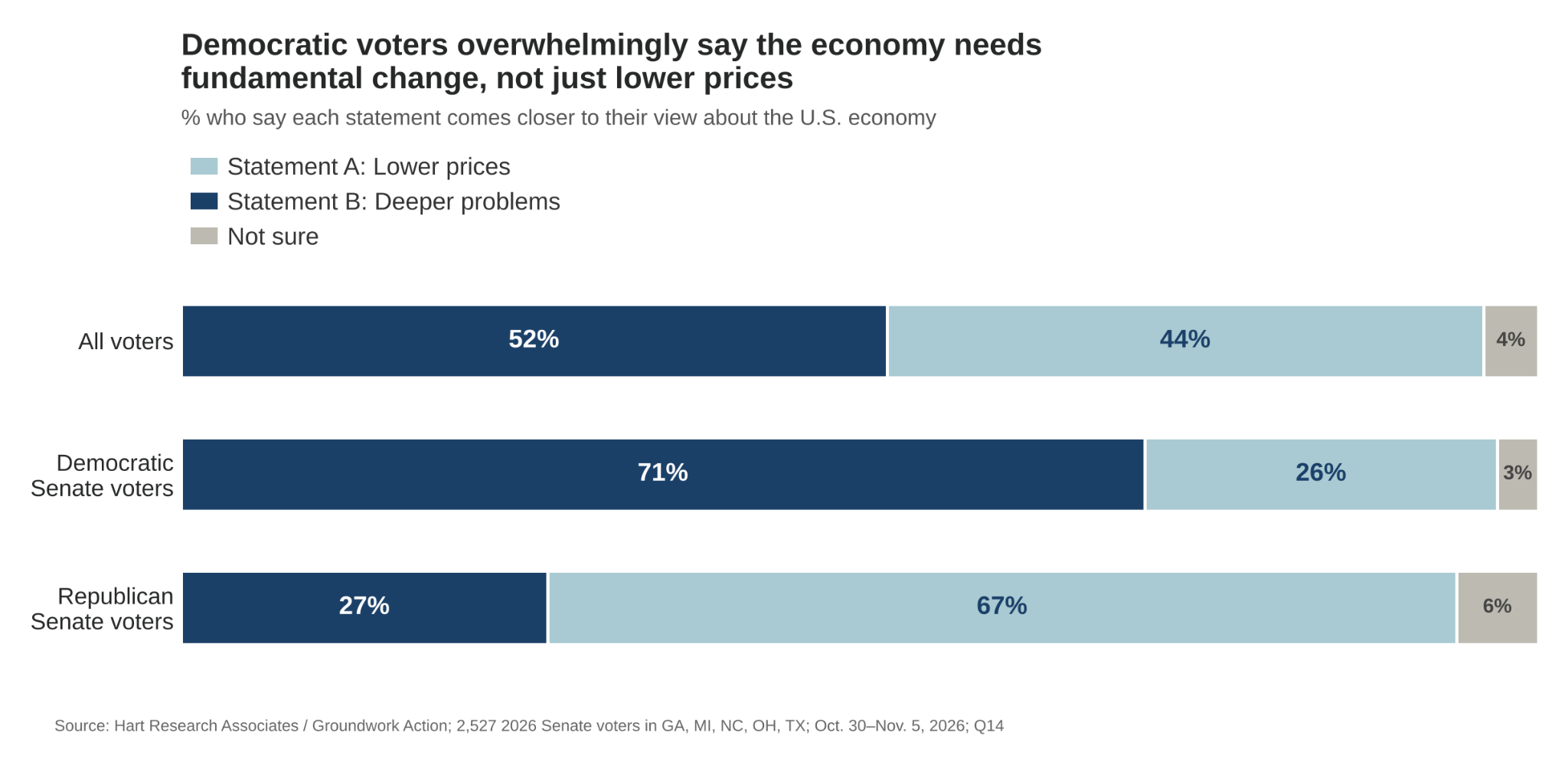
- However, a majority of voters (52%), including 71% of those who voted for Democrats, agreed that the “economy has deeper problems than just high prices for everyday essentials… what we really need are fundamental changes so the economy works for everyone, not just those at the top.”
- Only 26% of those who voted for Democrats believe that lowering prices is enough to make the economy work for most Americans again.
- Additionally, two thirds of voters who only sometimes support Democrats but did this year agree with the deeper problems critique.
- Additionally, nearly nine in ten voters think that our economic system needs changes, including 62% who feel that it needs major changes or a complete overhaul. Democratic Senate voters (84%) are notably more likely than Republican Senate voters (34%) to feel that it needs major changes or an overhaul.
2. Voters who supported the Democratic candidate for Senate strongly approve of a populist economic agenda, and they strongly associated that agenda with the Democratic Senate candidate.
- Previous Groundwork Action polling from this summer found that the vast majority of all voters (84%) said it was more important for their members of Congress to focus on economic issues than social issues. This new polling finds that among those who voted for the Democratic senate candidate, only 11% felt the Democratic candidate was more focused on social and cultural issues while 60% felt this way about the Republican candidate.
- The dynamic is a change from this summer, when we found the reverse: by a 49% to 16% margin, voters said the Democratic Party was more focused on social and cultural issues vs. economic issues. The Republican Party was seen as more focused economic issues than social and cultural issues, 40% to 37%.
- Economic populist goals and policies are important to supermajorities of voters across all five states. At least 89% of Democratic senate voters and 69% of Republican senate voters say each item tested is important, with top options including:
- Making sure that everyone who works hard can have a decent life with a little breathing room to pay bills and save for the future – 70% of all voters say it is very important, including 61% of Republicans
- Putting the interests of working- and middle-class Americans ahead of billionaires and big corporations – 67% very important, including 51% of Republicans
- Cracking down on price gouging and other things corporations do to keep prices high just to pad their profits – 66% very important, including 54% of Republicans
- A candidate with a populist economic agenda that includes all elements1 appeals to most Democratic senate voters, with 86% rating as highly appealing (8, 9, 10 rating on a 0 to 10 scale). More than half of Republicans (53%) rate it as highly appealing.
- Additionally, 81% of Trump defectors found the agenda appealing.
- Tellingly, 92% of Democratic Senate voters said they associated this highly popular agenda with the Democratic Senate candidate. This was true of 85% of the Trump defectors. Only 67% of these Trump defectors said so of the Democratic party overall.
3. Support for Democratic Senate candidates was grounded in more than simple opposition to Trump. Democratic Senate candidates were viewed more favorably than the Democratic Party overall, and bested their Republican opponents on key attributes like fighting corruption and lowering costs.
- Democratic Senate supporters indicated their vote was for their preferred candidate, not just a rejection of Trump and his party.
- 79% of these voters said they strongly supported the Democratic candidate (vs. just 21% who said they did so with mixed feelings).
- By 64% to 27%, they think the Democrat that they voted for is mainly focused on putting forward his own vision for fixing the economy, rather than mainly focusing on opposing Trump.
- All five Democratic candidates had higher net favorability than the party overall, with Cooper (+22 personal favorability vs. even party favorability) and Ossoff (+25 personal favorability vs. +5 party favorability) running the furthest ahead.
- The gap was especially pronounced among Trump Defectors: Democratic candidates’ net favorability was 83 points higher than the party (+74 vs. -9).
- In the aggregate across the states, Donald Trump (-20 net), the Republican Party (-16 net), and the Republican candidates (-19) were underwater.
- But big corporations were more unpopular than either party (-38) with just 29% favorable and 68% unfavorable.
- In each state, the Democratic candidate garnered more enthusiasm from their supporters than the Republican candidates did from theirs:
- Georgia: Jon Ossoff (87% strongly support) vs. Mike Collins (55%)
- Michigan: Abdul El-Sayed (73%) vs. Mike Rogers (67%)
- North Carolina: Roy Cooper (82%) vs. Michael Whatley (57%)
- Ohio: Sherrod Brown (72%) vs. Jon Husted (56%)
- Texas: James Talarico (78%) vs. Ken Paxton (46%)
- In every state but one, the top volunteered reason (24%) for supporting the Democrat was because he “cares about and fights for working people and people like me.” The top cited reason for North Carolinians who supported Cooper was his good record, experience, and background (40%).
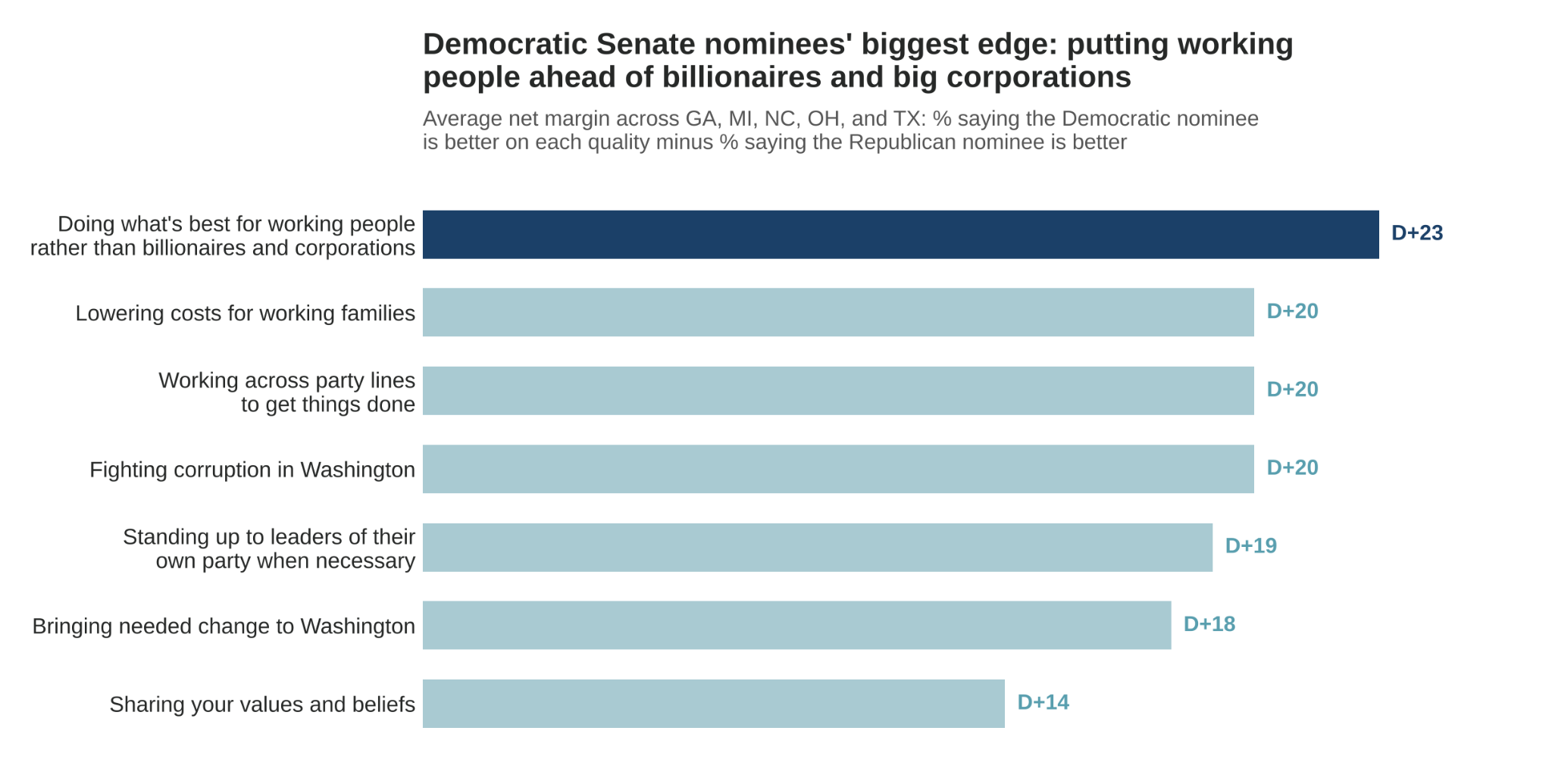
- Voters’ consensus top two most important qualities of a candidate were “lowering costs for working families” (56% of all voters included in their top two) and “doing what’s best for working people rather than billionaires and big corporations” (47%). The least important quality was “standing up to leaders of their own party when necessary” (10%).
- On every candidate quality tested, all five Democratic candidates outperformed their Republican opponent. On average, their biggest advantage was “doing what’s best for working people rather than billionaires and big corporations” (+23 better describes the Democratic candidate), with Ossoff earning the highest net rating (+31) on this attribute.
Conclusion
As much as the midterm result was a repudiation of President Trump and his administration, our research finds battleground voters supported Democrats in great part because of their vision for the economy, not just due to their blind opposition to Trump. That vision does not settle for simply addressing high prices, but also promises to confront a rigged system that voters believe needs fundamental reform.
These five candidates hail from battleground states Trump won multiple times, but each of which has the potential to be back in play again for Democrats come 2028. As the party prepares to wield power in Congress and launch campaigns for president, they should aim to emulate what each of these five successful candidates had in common.
The party’s brand, especially on the economy, is beginning to improve, but much of the growth is due to Trump’s disastrous actions. The challenge now is to turn what is a tenuous advantage into the kind of solid credibility the party currently enjoys on issues like healthcare. These five candidates represent a blueprint for building that trust. They ran ahead of the party on key issues and attributes by naming how large corporations and billionaires rig our economy to their benefit at our expense.
The new majorities in Congress should turn the rhetoric of these campaigns into tangible, attention-grabbing action. Previous Groundwork Action research on economic populist policies and potential oversight agendas suggest that voters in the base and those who could be persuaded to rejoin the coalition share a desire for the government to directly intervene in the economy on their behalf. Capping prices of everyday items like prescription drugs and hauling in CEOs of companies engaged in price-gouging are top priorities for the new Congress.
For leaders in the party who are preparing to launch presidential campaigns in the coming months, the same lessons apply. Americans are angry about the status quo, but when asked what their broader economic goals are, our research tells a simple but powerful story: people just want to have a fair chance to build a decent life that comes with a little breathing room. They’re waiting for leaders who promise to take on the billionaires, big corporations and corrupt politicians who make that goal harder to achieve.
- Full text of the populist economic agenda: “We need to fundamentally change our economy so that it works for everyone, not just those at the top. My goals are to: Crack down on price gouging and other things corporations do to keep prices high just to pad their profits; Take on the system of corruption that allows billionaires and big corporations to have outsized power and influence over our political and economic systems; Help more people reach the middle class and maintain a middle-class life; Make sure that everyone who works hard can have a decent life with a little breathing room to pay bills and save for the future; Put the interests of working- and middle-class Americans ahead of billionaires and big corporations.” ↩