What Separates a Winning Brand of Populism from Populism-Lite?
Hart Research recently conducted two national surveys of voters1 for Groundwork Action as part of a multi-phase research project to identify economic messaging that more effectively positions Democratic candidates to win back working-class voters and addresses voters’ demand for action on the affordability crisis.
Of particular note in our research, one in six voters (16%) identify as former Democrats who have drifted from the party but are not strongly aligned with Republicans. We consider this group of “gettable former Democrats” to be the key target segment for Democrats and an important audience for honing our economic pitch. This group of voters can help make Democrats the clear majority party in the country again.
Overview
Post-2024, there is a consensus within the Democratic party that the country has entered a populist moment. Democratic strategist James Carville has said “the Democratic Party must now run on the most populist economic platform since the Great Depression.” But what defines the right kind of economic populism that can win back “gettable former Democrats”?
While rising prices continue to dominate voters’ priorities, our new polling finds that across the political spectrum, voters see the affordability crisis as a symptom of fundamental problems with the country’s economic system that go beyond recent elevated inflation. To win in 2026 and build a durable Democratic majority, leaders must tell a broader story – one that diagnoses what went wrong, directly confronts those who broke the economy, and advances new, aggressive ideas to fix it.
Both Democratic base voters and our target group of “gettable former Democrats” share a core belief: our economy is unfairly rigged in favor of the wealthy and corporations and taking on these actors is necessary to lower prices. Old debates about the role of government are now largely settled questions: voters believe government should play an active role in the economy, and they prefer an approach that sets fair standards on the front-end and enforces rules that limit the power of billionaires and big corporations who have benefitted from the status quo over an approach with fewer regulations and redistribution on the back-end with subsidies and tax credits.
Only by forcefully confronting corporate power and calling for fundamental economic reform can Democrats close their credibility gap, earn back voters they have lost, and build the kind of durable economic mandate the party needs to govern and ensure everyday Americans have the ability to build a decent life.
Five Keys That Define a Winning Brand of Populism
Based on our research, we identify five keys that separate a winning brand of populism from a bland, “populism-lite” approach that gettable former Democrats are at risk of tuning out. We present these recommendations below.
Democrats should not tiptoe around calling out the state of the U.S. economy as fundamentally broken, or even “rigged.” In fact, failing to speak in plain terms on this point risks sounding out of touch.
- More than three in five voters (62%) think that our economic system is working poorly for them and their family, including not only 77% of Democrats and 73% of Independents, but also 44% of Republicans and 42% of Trump voters.
- Voters are looking for major changes to our economic system, not tinkering around the margins. Just 10% of voters think the economic system in the U.S. works pretty well today, while 67% think it needs a complete overhaul (25%) or major changes (43%). Two-thirds of “gettable former Democrats” (67%) think major changes or a complete overhaul of our current economic system is needed.
- More than two in three voters (67%) think the economy is “unfairly rigged” to benefit the wealthy and major corporations at the expense of everyone else, as opposed to believing it gives everyone a fair chance to succeed through hard work and determination (31%).
Put simply, “gettable former Democrats” don’t think it’s possible to address high prices in a real way without directly confronting the power held by billionaires and big corporations.
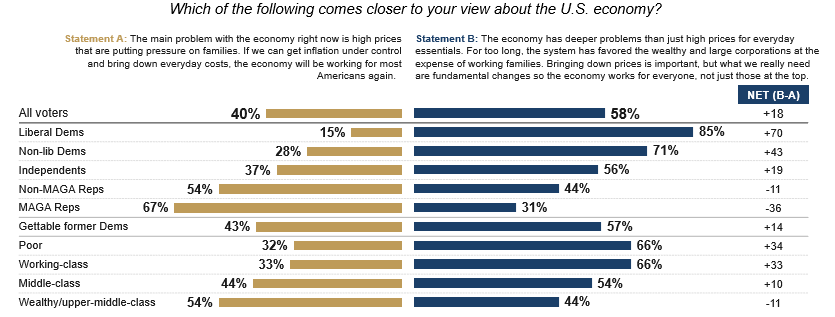
When asked to choose between two different approaches to improving our economy, a clear majority of voters believe that we need fundamental changes so the economy works for everyone, not just those at the top (58%) rather than just focusing on bringing down everyday costs (40%). By 57% to 43%, gettable former Democrats agree that fundamental changes are needed.
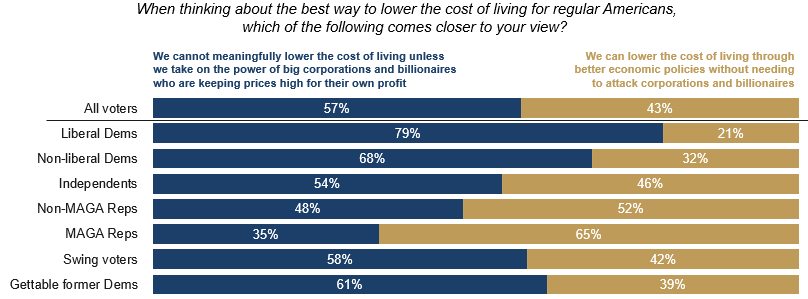
When it comes to lowering the cost of living for everyday Americans, 57% of voters, including 61% of “gettable former Democrats,” believe that “we cannot meaningfully lower the cost of living unless we take on the power of big corporations and billionaires who are keeping prices high for their own profit,” compared to the 43% of voters who believe we can lower the cost of living through better economic policies without having to attack corporations and billionaires.
There are some who worry that sharply critiquing big corporations may turn off some working-class people who aspire to make it rich themselves one day. Research finds this fear is overblown.
First, this aspiration is far from the main driver for voters right now. When asked what defines a decent life, voters emphasize practical considerations such as not having to stress about paying monthly bills (71% essential) and saving enough money for a comfortable retirement (65%). Notably, very few prioritize the goals of becoming a millionaire (5% essential) or starting their own business (9% essential).
Second, there is a widespread belief that billionaires and large corporations are contributing to a worsening of people’s economic situation. Significant majorities of voters say billionaires (72%), big corporations and CEOs (70%), Wall Street and big banks (65%), and big tech and AI companies (59%) have more of a negative than positive impact on the middle class.
Fully 81% of voters believe the economy should primarily ensure that “everyone who works hard can have a decent life with a little breathing room to pay bills and save,” while only 17% say it should ensure “anyone with a good idea and the initiative to pursue it has the chance to become wealthy.” Consensus holds across party lines, with 86% of Democrats, 70% of Independents, and 77% of Republicans coming down on the side of ensuring everyone who works hard can have a decent life, rather than have the chance to become wealthy.
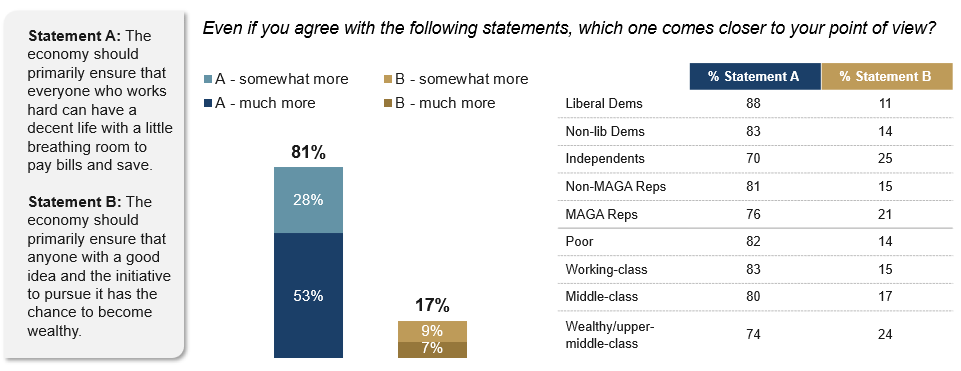
Rather than focusing on creating a path for individuals who want to become wealthy, our polling clearly shows that Democrats will be more responsive to voters’ priorities by advancing economic reforms that enable everyday Americans to build a decent life with breathing room to pay their monthly bills and handle unexpected expenses, save for retirement, and have the freedom to spend more time with their loved ones.
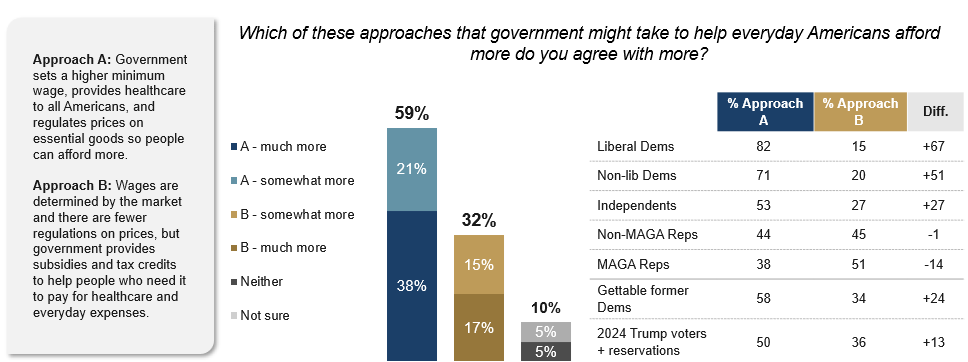
Voters have a clear view of what kind of government approach they think will best help the economy. By a wide margin, they prefer the government setting rules for our economy on the front end – meaning, directly cracking down on unfair corporate behavior – to the government providing subsidies and tax credits to help people on the back end.
When choosing between two approaches government might take to help with affordability, voters prefer by 59% to 32% that “government sets a higher minimum wage, provides healthcare to all Americans, and regulates prices on essential goods so people can afford more” over “wages being determined by the market and fewer regulations on prices, but government providing subsidies and tax credits to help people who need it to pay for healthcare and everyday expenses.”
Fully 77% of Democrats and 53% of Independents prefer the government setting rules on the front end, and even 41% of Republicans agree. Gettable former Democrats prefer this approach 58% to 34%.
Democrats should not worry that direct government action to bring down prices may seem heavyhanded. In our polling, the dominant critique of government is that it prioritizes the interests of billionaires, big corporations, and lobbyists (63%) rather than that government taxes too much, spends too much, and overregulates businesses (37%). Three in four voters believe the federal government should do more to solve problems and help meet the needs of people, compared to just 25% who say that the federal government is doing too many things better left to businesses and individuals. Indeed, fully 81% of voters think the federal government should take a more active role in solving economic problems facing the country.
There is broad and deep support for many proactive economic policies to fix the broken economy. Below are the 10 most popular proposals tested – all of which are strongly favored by significant majorities of voters.
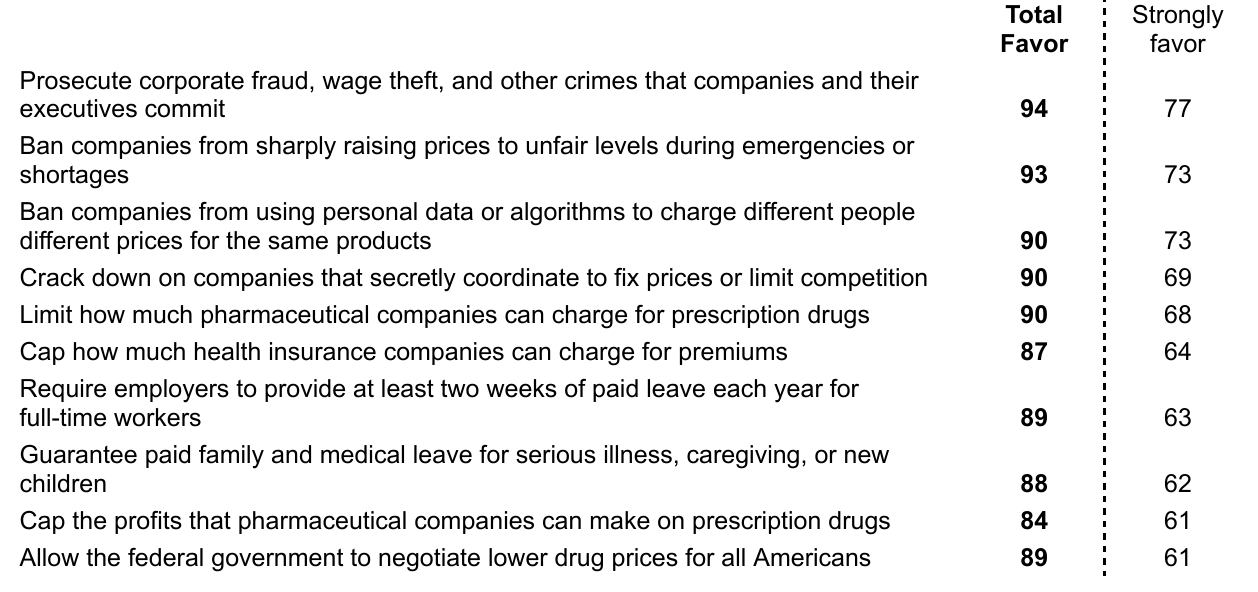
We were particularly struck by the popularity of direct government interventions when it comes to pricing. Overwhelming majorities of Americans want actions to limit rising prices for essential items, from utility rates (81% favor) to groceries (80%) to rent (85%). Crucially, they also want fundamental checks on the power companies have to set prices, whether it’s circumstantial (during an emergency) or operational (through new technologies and data collection). It reflects a cross-partisan, cross-ideological belief among voters that, since the pandemic, companies have crossed a line with consumers and they need to be corrected.
Falling just outside of these top-10 proposals were a set of tax fairness ideas. These included: capping excessive pay for executives at large corporations to ensure that CEOs are only paid more when workers are paid more (79% favor); raising the corporate income tax rate on corporations that pay their CEO more than 50 times as much as their average employee (77% favor); and requiring individuals with incomes over $100 million a year to pay a minimum tax of at least 20%, regardless of the sources of their income (77% favor).
Taken together, this set of proposals points at a potential three-part agenda:
- Cap or freeze prices for essential items
- Stop wrongdoing by corporate bad actors
- Make the wealthy and big corporations pay their fair share
Conclusion
The stakes for Democrats at this moment are extremely high. While voters unquestionably see Donald Trump’s tariffs, cuts to Medicaid, and war in Iran as making their lives more unaffordable, voters do not have particularly high levels of confidence in either party to make the changes needed in the U.S. economic system.
When it comes to the Democratic party, voters in our survey named a number of concerns that cause them to doubt Democrats’ economic approach. Among them:
- Democrats think it’s enough to be in opposition to Trump and Republicans without putting forward their own vision for fixing the economy – 72% concern, 48% major concern
- Democrats always talk about helping the working class, but when push comes to shove, they do not follow through – 71% concern, 45% major concern
- Democrats have become so dependent on campaign donations from the ultra-wealthy and Corporate America that business interests get prioritized over the needs of working and middle-class Americans – 67% concern, 42% major concern
On top of these criticisms, more voters in our survey say the Democratic Party looks out for the interests and needs of big corporations (56%) and billionaires (51%) than for “people like you” (49%). To address these concerns, Democrats need to put forward a clear and compelling vision that goes beyond mere opposition to Trump and signals a genuine resolve to take on billionaires and big corporations.
By now, everyone knows that cost-of-living is the No. 1 issue in America. But not all talk about affordability is created equal. It is very easy to slip into a mushy, bland form of populism-lite that fails to convince a skeptical public that anything will change. The candidates most likely to break through during this election cycle will be those who embrace a brand of populism that directly calls out the corporate corruption that voters believe has made life unaffordable and our economy unfair.
Methodology
Hart Research Associates conducted two national surveys of U.S. voters on behalf of Groundwork Action, as part of a multi-phase research project on economic messaging. The first survey reached 2,017 U.S. voters from May 6 to 11, 2026. The second reached 2,000 U.S. voters from May 28 to June 2, 2026. Both surveys were conducted online, and respondents were matched to the voter file. Figures for subgroups — including “gettable former Democrats” — are drawn from smaller samples than the full electorate and should be read accordingly.
- Two surveys: 2,017 U.S. voters, May 6–11, 2026; and 2,000 U.S. voters, May 28–June 2, 2026. See Methodology. ↩